How do you reduce complexity, transportation costs and risk of damage - without compromising the product?
This was precisely the challenge Katla faced.
When multiple formats create unnecessary complexity
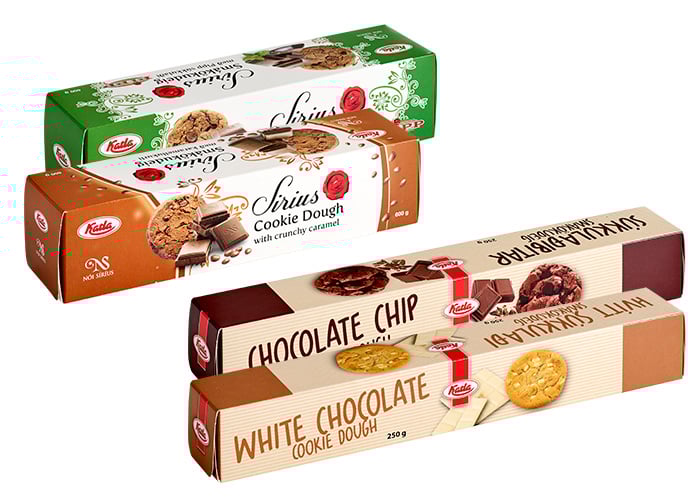
Katla produces raw cookie dough in several variants, which were originally packaged in three different sizes.
Two of the variants were packed in 600g and 800g cartons, while the third 280g variant was packed in printed plastic film.
This created a logistical challenge:
All three formats had to be packed in the same outer carton.
But with different packaging types and sizes, inefficient use of space - and therefore air in the packaging - quickly developed. This is a critical challenge, especially when transporting over long distances where stability and protection are crucial.
Why the standard solution was not optimal
We reviewed different options and visualized the setups for Katla.
The conclusion was clear: the existing and desired formats could not be optimally combined without wasted space.
Voids in the outer cartons would not only result in poorer pallet utilization, but also
- Increase the risk of damage during transportation
- Create unnecessarily high transportation costs
- Make the packaging structure more complex
From wasted space to structured packaging
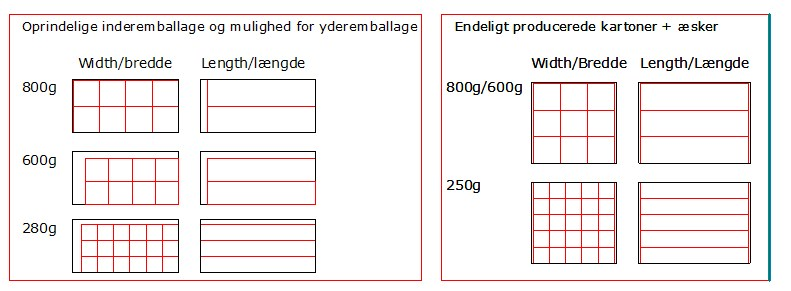
The illustration clearly shows the difference between the original and optimized packaging solution.
On the left, you can see how different packaging types and sizes create uneven packing and waste space in the outer carton. On the right, the packaging is standardized to optimize the format in both width and length.
It is precisely this type of packaging optimization that makes it possible to reduce waste space and ensure more stable transport packaging.
A standardized approach with fewer formats
In close dialog with Katla, we came up with a solution based on the whole rather than the individual products.
The solution included:
- Combining 600 g and 800 g in one common carton box
- Converting the 280g variant from plastic film to cartons
- Adjusting the 280g variant to 250g to achieve uniform dimensions
This made it possible to standardize the packaging and create a much more efficient use of space:
- 5 x 250g matches the format of 3 x 600/800g
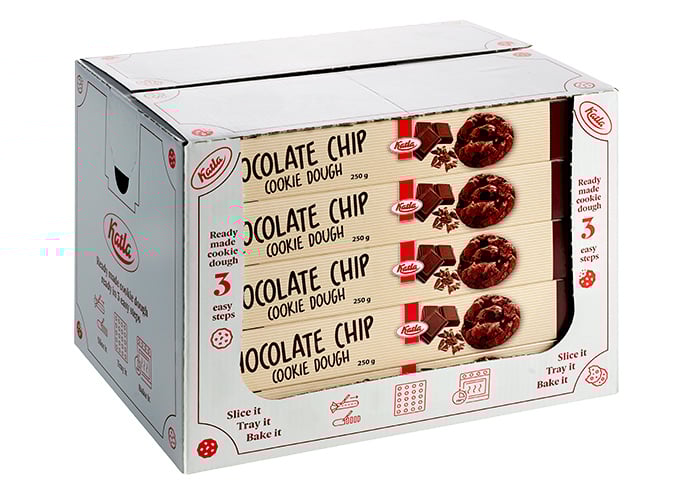
- One common outer carton for all cookie dough variants
- The outer carton is palletized and acts as transport packaging
Less waste, lower costs and stronger logistics
By rethinking the packaging structure, Katla achieved a number of tangible benefits:
- More efficient packaging without wasted space
- Lower transportation costs
- Increased product safety during transportation
- Fewer packaging variants and simpler setup
- More efficient production with fewer changeovers
At the same time, sales packaging was developed in cardboard, where the formats match each other in terms of quality and ensure a uniform look.
Small adjustments - big impact on the entire value chain
The case shows how packaging optimization and standardization can create value far beyond the packaging itself.
By thinking holistically rather than in terms of individual products, you can optimize:
- Logistics
- Production
- Costs
- Transportation efficiency
Small changes in product and packaging design can have a big impact on the entire value chain.
Can your packaging be optimized too?
Do you have multiple packaging formats that create complexity in production or logistics?
At BetaPack, we help you identify optimization potentials and develop packaging solutions that reduce costs and improve efficiency.
Contact Helle Rasmussen on +45 4414 4401 or hra@betapack.dk for a no-obligation chat about how your packaging can be optimized
.png?width=123&height=55&name=logo%20(2).png)

New packaging solution helps Aabybro Mejeri and BetaPack cut plastic use
In the spring of 2024, BetaPack’s Key Account Manager, Helle Rasmussen, reached out to Aabybro Mejer …
A responsible choice: Valsemøllen partners with BetaPack for packaging solutions
In an interview with Mads Strandgaard Jensen, Packaging Buyer at Valsemøllen, he shares the requirem …
Innovative packaging solutions for the pet food industry
Since 1997, United Petfood Group (UPG) has been one of the leading companies in the pet food industr …